
Searching Jim Hogg County Criminal Dockets
The 229th Judicial District Court archive covers district-level cases. It posts dated PDFs of criminal, trial, regular, and combined dockets. Each file covers one day of court business. It is not a full case history. The District Clerk's Find My Case search adds active modes. Search by case number, driver's license and state, or first name, last name, and birth date. One gap: the blank form has no criminal case-type filter. Not every Jim Hogg County criminal docket record lives on the district side. Class A and B misdemeanors route to the Constitutional County Court. Fine-only misdemeanors and magistrate matters belong to one of four Justice Courts. The County Clerk keeps a separate Tyler endpoint for county-side matters. Follow the court printed on your notice or citation. One empty result does not settle the question.
- Identify the district, county, or JP court level.
- Check the latest district PDF for a felony setting.
- Use the matching clerk search with a known number or active name fields.
- Call the clerk or coordinator when a file is missing, old, or restricted.
- Request the specific indictment, order, judgment, or certified docket record.
Jim Hogg Criminal Search Screens
Two search screens exist for a reason, and each one serves a different clerk. On the district side, the District Clerk search screen is where felony docket lookups begin.
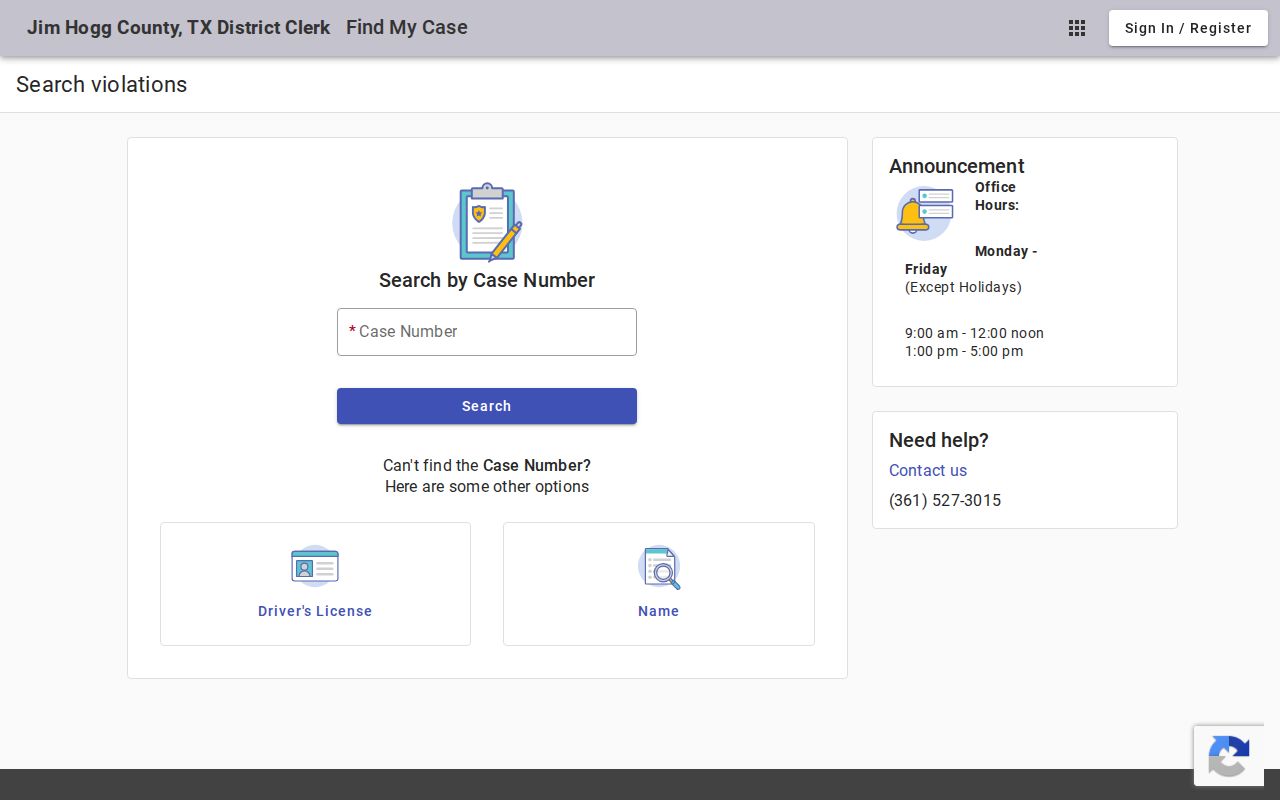
That screen lets you search by Case Number, Driver's License, or Name. The boxes for Social Security number, vehicle, and business name sit inactive. For a Jim Hogg County misdemeanor case, use the County Clerk Find My Case screen instead.
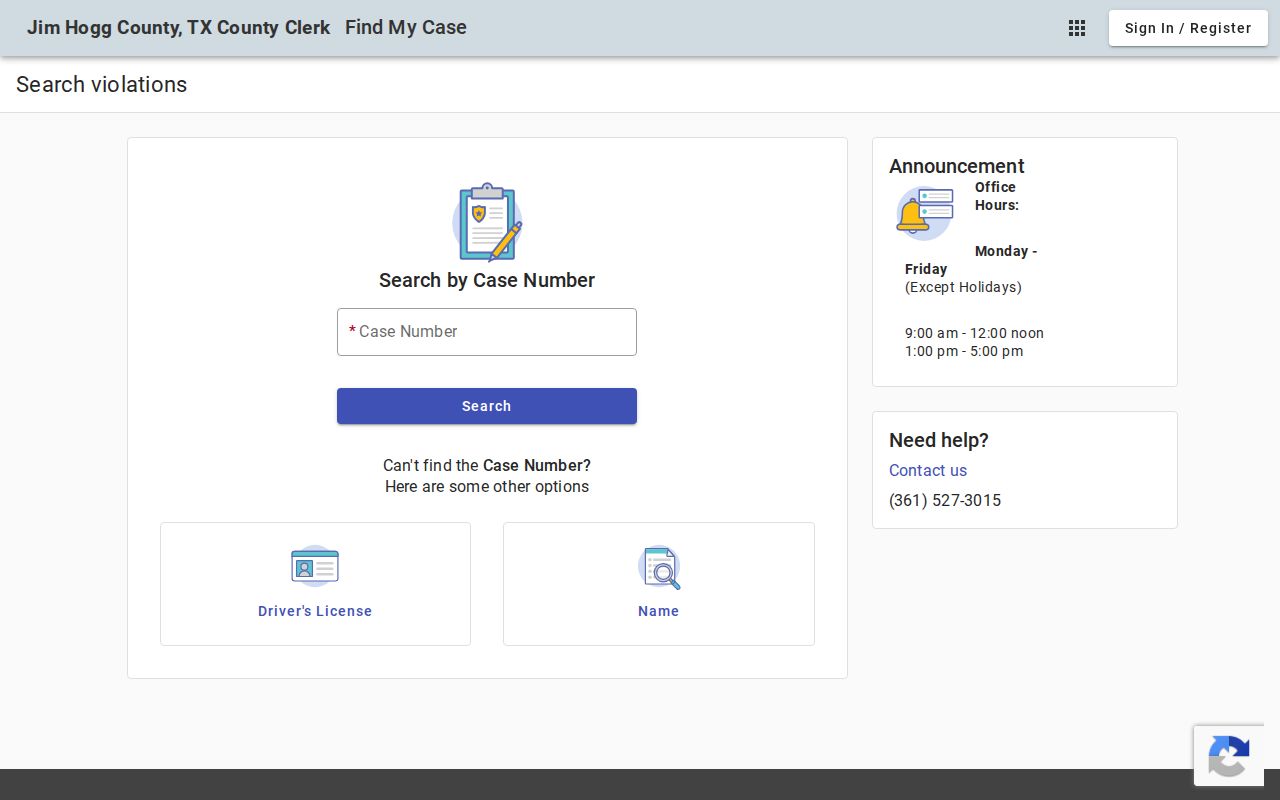
The matching layouts can fool you. Pick the clerk whose court actually holds the case, because querying the wrong side returns nothing and makes a real Jim Hogg County court docket look like it does not exist.
Inside a Jim Hogg County Criminal Docket
A district trial and regular docket sheet runs on five core columns. It sorts everything into "JAIL CASES" and "NON JAIL CASES." Those labels only tell you how the sheet groups matters. They say nothing about guilt or current custody. A charge is an allegation or a case classification, never a conviction.
| Cause No. | An observed pattern resembles YY-CRJ-NN. No official legend was found. |
|---|---|
| Style | The caption starts “The State of Texas vs.” followed by the accused person. |
| Setting | Trial selection, bond motions, fee matters, announcement, and diversion settings appear. |
| Attorney | Counsel appears, but a stable side label was not confirmed. |
| Notes | May mention a plea, scheduling fact, docket-control order, or FTA date. |
The PDF is thin. It skips most filings, document images, full bond data, and the complete disposition history, so a signed order or judgment controls.
Jim Hogg Criminal Setting Terms
Some setting labels sound like outcomes when all they mark is work the court has scheduled. Treat each entry as an event, and your docket search stays anchored to what the paper actually proves.
- Trial or jury selection
- A trial-related setting, not proof of verdict.
- Entry of DCO
- An acronym found in the sample whose local expansion was not confirmed.
- Motion to reinstate bond
- A hearing on a request, not the ruling.
- Motion to adjudicate guilt
- A state motion setting, not a finding that it was granted.
- Announcement or dismissal
- A setting label. The written disposition controls.
- Pre-trial diversion contract
- A procedural setting, not proof of completion or dismissal.
How a Jim Hogg Criminal Case Moves
One Jim Hogg County cause number can fill many docket lines. The court record opens when a charge or indictment is filed. Arraignment follows so the defendant can face the charge and enter a plea.
From there, pretrial settings handle discovery, bond, motions, and scheduling. A plea or a trial may settle the merits. Resets just add dates and keep the case alive.
The official result lives in the written judgment and sentence, not in a docket notation alone.
Docket flow: Charge Filed › Arraignment › Pretrial › Plea or Trial › Disposition › Sentencing
A setting sheet is one snapshot. For the full register of actions or a final paper, ask the unified County and District Clerk, whose district side keeps the underlying district court file.
Jim Hogg Criminal Cases in 2024
How busy was the Jim Hogg criminal docket in fiscal year 2024? The Texas Office of Court Administration gives the answer in broad strokes. No defendant names are attached. District criminal cases in Jim Hogg County started the period with 220 active pending. Another 85 were added, and 1 came back as reactivated. Of those, 77 were disposed, and 12 went inactive. That left 160 active pending cases when the period closed.
Read these as workload counts rather than case outcomes. A "disposed" case tells you it ended, but not how, since dismissal, plea, trial, and other routes all land under that one word.
Courts That Hold Criminal Dockets
Felony work in the Jim Hogg County criminal docket belongs to the 229th District Court. That court also serves Starr and Duval counties. Say "Jim Hogg County" when you call. Criminal coordinator Marisela Chapa answers at (361) 279-6233. District-side clerk staff at (361) 527-4031 can pull the file. Misdemeanors are different. The Constitutional County Court takes original Class A and B misdemeanors, per the county's own description. It also hears appeals from JP Class C cases.
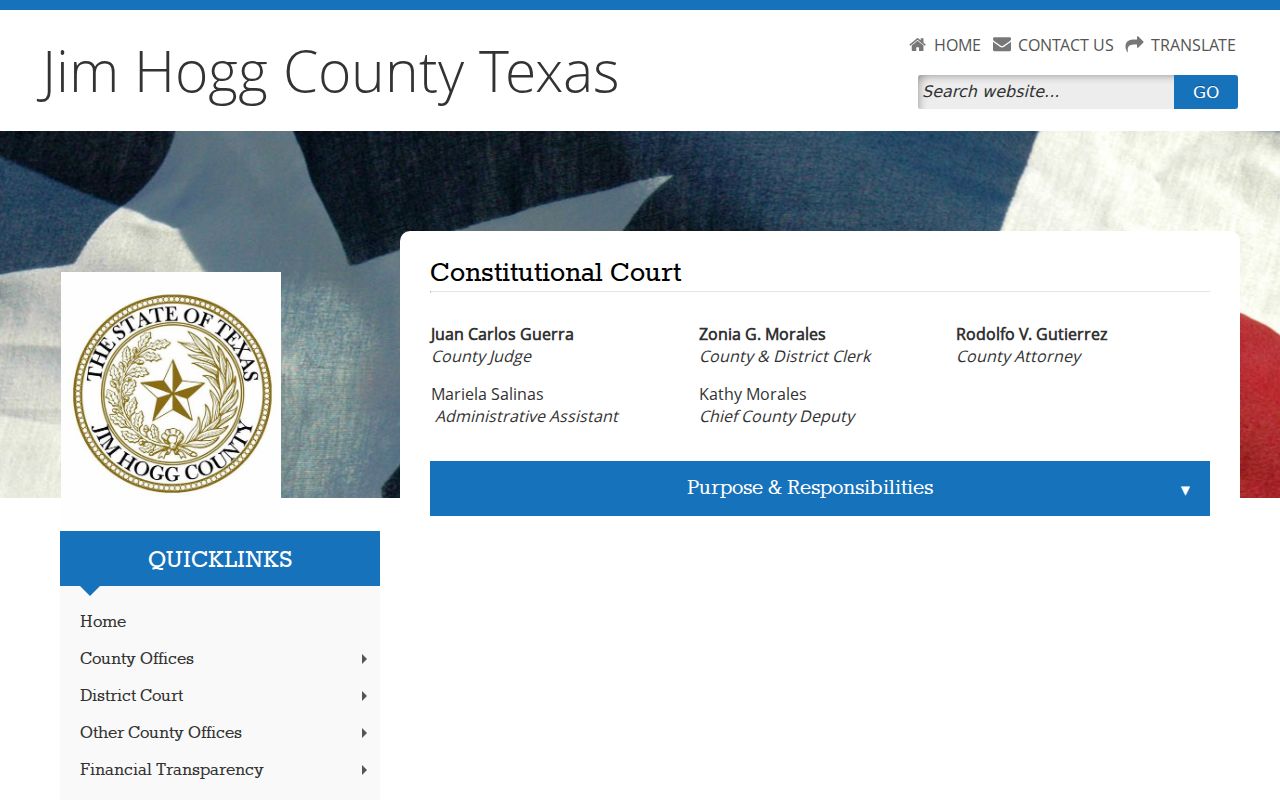
County-level cases run through the county side of that same clerk office. Fine-only matters land in a Justice Court at 133 East David Street, and all four precincts share one number, (361) 527-5830. A district PDF will not stand in for a JP docket, so ask the Justice Court directly.
When Jim Hogg Records Disagree
Notice, portal result, PDF. Three matches can show three different update times in Jim Hogg County. Check the cause number, the court, the county, and the setting on each one before trusting any of them. For the current district setting, call the coordinator. Rae Gutierrez handles the clerk's district side, and she can get you the filed record. Ask her for a plain or certified copy and confirm the fee.
A no-result is not a disposition. It may reflect the wrong clerk, a narrow dataset, a new or archived file, a restriction, or mismatched input.
You have several ways to reach the Jim Hogg County clerk. Visit at 102 E. Tilley in Hebbronville, call, mail a focused request to P.O. Box 878, Hebbronville, TX 78361, fax (361) 232-5875, or use an official staff email. Public-terminal access is unconfirmed. Call first. re:SearchTX may hold allowed records from participating courts. Local integration and criminal coverage remain unconfirmed. eFileTexas is a filing tool, not a complete public docket viewer.
Sealed Dockets and Public Access
Court records in Texas sit outside the usual Public Information Act path. That path covers other government offices. Rule of Judicial Administration 12 sets its own request and review process for judicial records. A good written request names the court, the cause number or date, and the exact document wanted. If the office says no, ask for the denial in writing. Also ask for the Rule 12.9 review route. Some Jim Hogg County records face extra limits. Family Code Chapter 58 can restrict juvenile case files. Rule 21c requires sensitive data to be redacted. Code of Criminal Procedure Chapter 55A governs expunction. An empty docket search proves nothing about expunction, dismissal, or innocence. Ask the clerk whether a public or redacted version can be released.
Key rules:
Rule of Judicial Administration 12 sets the judicial-record request path.
Family Code Chapter 58 restricts juvenile access.
Code of Criminal Procedure Chapter 55A governs expunction.
Jim Hogg Criminal Copy Requests
A posted calendar can confirm a hearing date. But it is not a certified court record. If you want the paper behind a docket entry, ask the clerk directly. Name the court and state that the case is in Jim Hogg County. Give the cause number if you have it, and say which document you need. Good examples are an indictment, plea papers, a bond order, a judgment, a sentence, a notice, or the register of actions. A narrow request gets routed faster and priced accurately.
The fee baselines sit in Texas Government Code Chapter 51. The clerk sets the final total. Expect a $5 district-clerk search when no docket number is supplied. A certification certificate with seal costs $5. Printed copies run $1 per page. An electronic document of up to ten pages also costs $1. Longer electronic documents are ten cents per page. The county links a 2025 local schedule. Check its line items before you pay. Also ask about payment methods and any extra search or certification charges up front.
One elected office handles counter, phone, mail, fax, and a listed email contact. That does not mean the files merge. Say "district criminal" or "county criminal" when you write or call. The courts and their case files stay distinct.